.svg)


How Does Scent Affect Cognitive Health: What We Learned from Dr. Robert Leon
We’ve always been interested in exploring the frontier of longevity science—especially when it intersects with everyday quality of life. Recently, Ciela had the privilege of hosting Dr. Robert Leon, Professor Emeritus of Neurobiology and Behavior at the University of California, Irvine, whose groundbreaking research explores a fascinating question:
Can scent improve memory—while we sleep?
The answer, increasingly, appears to be yes.
The Science: Why Smell Is Different
Unlike our other senses, smell has a uniquely direct pathway to the brain’s memory centers, particularly the hippocampus and limbic system. This is why a single scent can instantly transport you back decades.
Dr. Leon’s research builds on this biological advantage. Rather than relying on conscious effort or training, his work taps into the brain’s natural nighttime processes, when memory consolidation is already happening.
As highlighted in one of the studies he discussed, “the olfactory sense has the special privilege of being directly connected to the brain’s memory circuits” .
The Breakthrough: Memory Improvement During Sleep
In a recent study from UC Irvine, older adults were exposed to different scents each night during sleep over several months. The results were remarkable:
• Participants experienced a 226% improvement in memory performance compared to the control group
• Brain imaging showed stronger neural pathway integrity
• Improvements were achieved without active effort—only passive exposure during sleep
This is especially significant because memory decline is one of the most feared aspects of aging—and one of the hardest to address.
From Research to Reality: The Memory Air Device
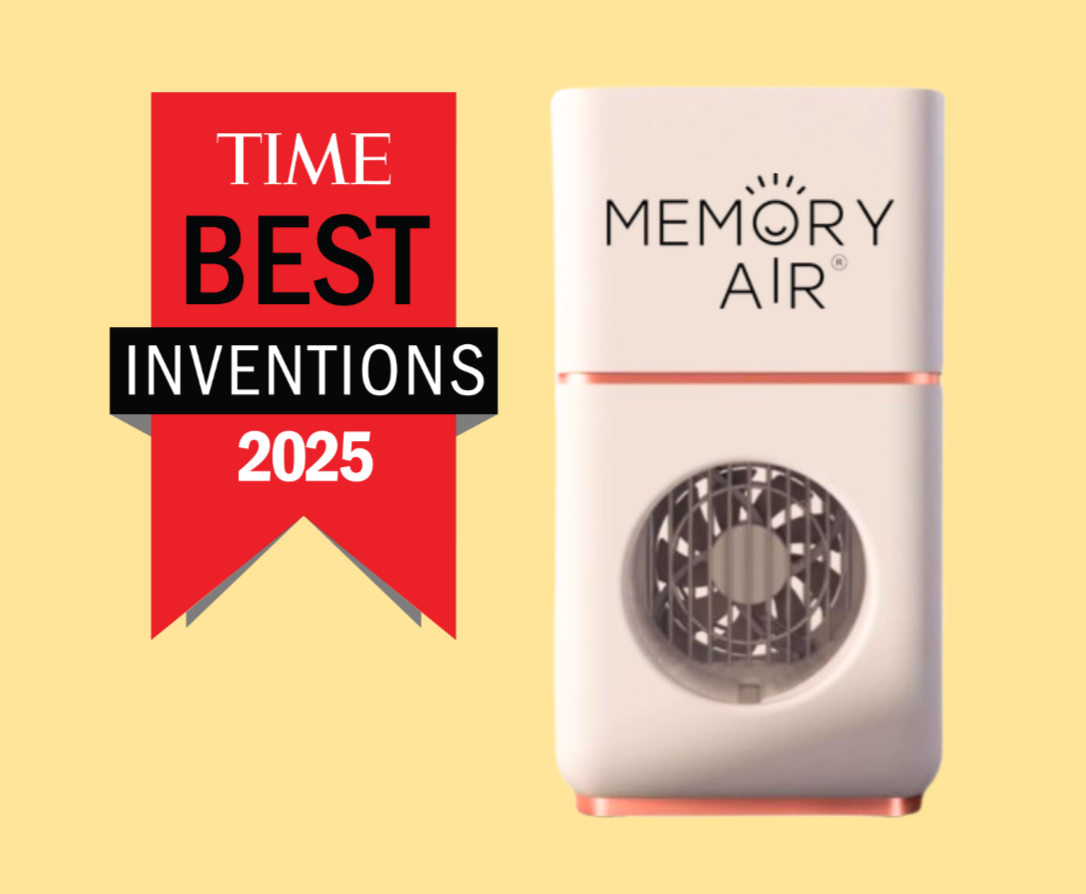
Building on this research, Dr. Leon and his collaborators developed the Memory Air device—a breakthrough technology designed to bring this science into everyday life.
In 2025, the device was recognized as one of TIME Magazine Inventions of the Year 2025, underscoring its potential to reshape how we think about brain health and aging.
What makes Memory Air so compelling is its simplicity and precision:
• It releases scents during sleep, aligning with the brain’s natural memory consolidation cycles
• It rotates 39 different scents throughout the night, preventing sensory habituation
• It delivers passive, non-invasive cognitive stimulation—no effort required from the user
This rotating scent exposure is key. Rather than allowing the brain to “tune out” a single smell, the device continuously introduces novelty, keeping the olfactory system—and by extension, memory pathways—actively engaged.
How It Works: “Training” the Brain at Night
During sleep, the brain undergoes a process called memory consolidation, where experiences from the day are stabilized and stored.
Dr. Leon’s approach uses scent as a subtle signal to:
1. Stimulate neural pathways tied to memory
2. Enhance communication between brain regions
3. Potentially slow or counteract cognitive decline
In earlier studies, participants rotated through a smaller set of scents. Memory Air expands this concept dramatically, scaling it into a dynamic, nightly sensory experience.
The Role of Aromatherapy: Which Scents Matter?
Research in this area often includes scents such as:
• Rose
• Lavender
• Eucalyptus
• Lemon
• Peppermint
These are not chosen arbitrarily; they are known to activate different emotional and cognitive responses.
According to supporting research, consistent nighttime exposure to aromatherapy oils may enhance memory and cognitive function, though more large-scale studies are still needed .
Why This Matters for Aging and Longevity
What makes this research so compelling is not just the outcome, but the method:
• It is non-invasive
• It requires no behavioral change or effort
• It integrates seamlessly into daily life
As one article noted, decline in the sense of smell is often an early indicator of neurological disease —making this pathway not just therapeutic, but potentially diagnostic.
From Innovation to Experience at Ciela
At Ciela, we think deeply about how emerging science can translate into meaningful lived experience. We’ve learned that the brain may be more adaptable than we think—even while we sleep.
Dr. Leon’s work raises powerful possibilities:
• Could scent-based therapies become part of future cognitive wellness programs?
• Could personalized olfactory environments support memory care and early intervention?
• Could something as simple—and elegant—as scent during sleep become part of a longevity protocol?
These are the kinds of questions that define the future of senior living—not just extending lifespan, but enhancing brain health, dignity, and vitality.